
Economics
Associate Degree 4
Bachelor Degree 12
Faculty of Communication 1
Faculty of Engineering and Technology 2
Faculty of Economic and Administrative Sciences 4
FACULTY OF ARTS AND SCIENCES 4
Faculty of Law 1
Masters Degree 33
Graduate School of Social Sciences — with thesis 12
- Master Program in Business Administration
- Master Program in Economics
- Master Program in French Literature and Language
- Master Program in International Relations
- Master Program in Media and Communication Studies
- Master Program in Philosophy
- Master Program in Political Sciences
- Master Program in Private Law
- Master Program in Strategic Communications Management
- Masters in Sociology
- Production Management and Marketing Master Program
- Public Law Master Program
Graduate School of Social Sciences — without thesis 13
- DEPARTMENT OF SPORTS MANAGEMENT (INTERDISCIPLINARY)
- Non Thesis Master Program in Marketing Communication Managament
- Non-Thesis Master Program in Business Administration
- Non-Thesis Master Program in Communication Strategies and Public Relations
- Non-Thesis Master Program in Economic Law
- Non-Thesıs Master Program ın Fınancıal Economıcs
- Non-Thesis Master Program in Health Law
- Non-Thesis Master Program in Human Rights Law
- Non-Thesis Master Program in International Relations
- Non-Thesıs Master Program ın Marketıng and Logıstıcs Management
- Non-Thesis Master Program ın Polıtıcal Scıences
- Non-Thesıs Master Program ın Socıologıcal Studıes on Turkey
GRADUATE SCHOOL OF SCIENCE AND ENGINEERING — with thesis 5
GRADUATE SCHOOL OF SCIENCE AND ENGINEERING — without thesis 3
Doctoral Degree 12
Graduate School of Social Sciences 9
- Doctoral Program in Business Administration
- Doctoral Program ın Economıcs
- Doctoral Program in International Relations
- Doctoral Program in Media and Communication Studies
- Doctoral Program in Philosophy
- Doctoral Program ın Polıtıcal Scıences
- Doctoral Program ın Prıvate Law
- Doctoral Program in Public Law
- Doctoral Program in Sociology (In French)
GRADUATE SCHOOL OF SCIENCE AND ENGINEERING 3
Programme Details
| # | Course Code | Prerequisites | Course Name | Course Type | Theory | Practice | Lab | ECTS | Erasmus |
|---|---|---|---|---|---|---|---|---|---|
| 1 | ECON111 | - | Introduction to Economics | Compulsory | 4 | 0 | 0 | 6 | |
| 2 | ECON115 | - | Economic History | Compulsory | 3 | 0 | 0 | 4 | |
| 3 | ECON103 | - | Mathematical Analysis | Compulsory | 4 | 0 | 0 | 4 | |
| 4 | ECON117 | - | Introduction to Social Sciences | Compulsory | 0 | 0 | 3 | 3 | |
| 5 | ECON121 | - | Methodology I | Compulsory | 2 | 0 | 0 | 2 | |
| 6 | ECON151 | - | Programming with Python | Compulsory | 0 | 0 | 3 | 3 | |
| 7 | FLF101 | - | French Cef B2.1 Academical | Compulsory | 0 | 0 | 0 | 2 |
| # | Course Code | Prerequisites | Course Name | Course Type | Theory | Practice | Lab | ECTS | Erasmus |
|---|---|---|---|---|---|---|---|---|---|
| 1 | ECON104 | - | Multivariate Functions | Compulsory | 0 | 0 | 4 | 6 | |
| 2 | ECON102 | - | Macroeconomics I | Compulsory | 0 | 0 | 3 | 5 | |
| 3 | ECON114 | - | Methodology II | Compulsory | 0 | 2 | 2 | 2 | |
| 4 | ECON108 | - | Microeconomics I | Compulsory | 0 | 3 | 3 | 5 | |
| 5 | ECON152 | ECON151 | Data Science with Python | Compulsory | 0 | 0 | 3 | 4 |
| # | Course Code | Prerequisites | Course Name | Course Type | Theory | Practice | Lab | ECTS | Erasmus |
|---|---|---|---|---|---|---|---|---|---|
| 1 | ECON215 | ECON108 | Microeconomıcs II | Compulsory | 3 | 0 | 0 | 5 | |
| 2 | ECON203 | ECON102 | Macroeconomics II | Compulsory | 3 | 0 | 0 | 5 | |
| 3 | ECON211 | - | Accounting | Compulsory | 0 | 0 | 2 | 3 | |
| 4 | ECON207 | - | Mathematical Statistics I | Compulsory | 4 | 0 | 0 | 6 | |
| 5 | ECON209 | - | Linear Algebra | Compulsory | 3 | 3 | 0 | 5 | |
| 6 | ECON205 | - | Monetary Theory and Finance | Compulsory | 3 | 0 | 0 | 4 |
| # | Course Code | Prerequisites | Course Name | Course Type | Theory | Practice | Lab | ECTS | Erasmus |
|---|---|---|---|---|---|---|---|---|---|
| 1 | ECON216 | ECON215 | Microeconomics III | Compulsory | 0 | 0 | 3 | 5 | |
| 2 | ECON210 | - | Differential Equations | Compulsory | 0 | 0 | 3 | 4 | |
| 3 | ECON254 | ECON151 | Numerical Methods and Analysis | Compulsory | 0 | 0 | 3 | 5 | |
| 4 | Econ218 | ECON203 | Macroeconomics lll | Compulsory | 3 | 3 | 3 | 5 | |
| 5 | ECON208 | ECON207 | Mathematical Statistics II | Compulsory | 0 | 0 | 3 | 4 |
| # | Course Code | Prerequisites | Course Name | Course Type | Theory | Practice | Lab | ECTS | Erasmus |
|---|---|---|---|---|---|---|---|---|---|
| 1 | ECON401 | - | Industrial Economics | Compulsory | 3 | 0 | 0 | 6 | ✓ |
| 2 | ECON405 | ECON210 | Growth Theories | Elective | 3 | 3 | 0 | 6 | ✓ |
| 3 | ECON407 | - | Economics of information and uncertainty | Elective | 3 | 0 | 0 | 6 | ✓ |
| 4 | ECON409 | - | History of Economic Thought | Elective | 3 | 3 | 0 | 6 | ✓ |
| 5 | ECON413 | - | Labor Economics | Elective | 3 | 0 | 0 | 6 | ✓ |
| 6 | ECON442 | - | Political Economy and Institutions | Elective | 3 | 0 | 0 | 6 | ✓ |
| 7 | ECON419 | - | Financial Econometrics and Modeling | Elective | 3 | 0 | 0 | 6 | ✓ |
| 8 | ECON455 | - | Economy of the European Union | Elective | 3 | 0 | 0 | 6 | ✓ |
| 9 | ECON423 | - | Behavioral Economics | Elective | 3 | 0 | 0 | 6 | ✓ |
| 10 | ECON323 | - | Applied Research Project | Elective | 2 | 0 | 0 | 4 | |
| 11 | ECON411 | - | End of studies dissertation I | Compulsory | 0 | 0 | 3 | 6 | |
| 12 | ECON400 | - | End of studies dissertation | Compulsory | 6 | 0 | 0 | 12 |
| # | Course Code | Prerequisites | Course Name | Course Type | Theory | Practice | Lab | ECTS | Erasmus |
|---|---|---|---|---|---|---|---|---|---|
| 1 | ECON471 | - | Development Economics | Compulsory | 3 | 0 | 0 | 6 | |
| 2 | ECON404 | - | Current problems of the Turkish economy | Compulsory | 3 | 0 | 0 | 6 | |
| 3 | ECON417 | - | Selected Topics in Public Economics | Elective | 3 | 0 | 0 | 6 | |
| 4 | ECON428 | - | Dynamic Macroeconomics | Elective | 3 | 3 | 0 | 6 | |
| 5 | ECON426 | - | Game theory | Elective | 3 | 0 | 0 | 6 | |
| 6 | ECON424 | - | Social Security Policies | Elective | 0 | 0 | 3 | 6 | |
| 7 | ECON458 | - | Globalization and Financial Crises | Elective | 3 | 0 | 0 | 6 | |
| 8 | ECON421 | - | Financial markets | Elective | 3 | 0 | 0 | 6 | |
| 9 | ECON446 | - | Economics of Inequality | Elective | 0 | 0 | 3 | 6 | |
| 10 | ECON324 | - | Spatial Economics | Elective | 0 | 0 | 3 | 6 |
| # | Course Code | Course Name | Course Type | Theory | Practice | Lab | ECTS | Erasmus |
|---|---|---|---|---|---|---|---|---|
| 1 | CC301 | Introduction to Psychology | Elective | 2 | 0 | 0 | 3 | ✓ |
| 2 | CC303 | Financial Literacy | Elective | 2 | 0 | 0 | 3 | ✓ |
| 3 | CC305 | Ethnomusicology | Elective | 2 | 0 | 0 | 3 | ✓ |
| 4 | CC314 | Cultural Heritage | Elective | 2 | 0 | 0 | 3 | ✓ |
| 5 | CC316 | Data Visualization and Storytelling | Elective | 2 | 0 | 0 | 3 | ✓ |
| 6 | CC318 | Duygular Tarihi ve Görsel Kültür | Elective | 2 | 0 | 0 | 3 | ✓ |
| 7 | CC315 | Elective | 2 | 0 | 0 | 3 | ✓ | |
| 8 | CC317 | Elective | 2 | 0 | 0 | 3 | ✓ | |
| 9 | CC321 | Elective | 2 | 0 | 0 | 3 | ✓ | |
| 10 | CC325 | Latin American Culture: Identity, Mythology, and Everyday Life | Elective | 2 | 0 | 0 | 3 | ✓ |
| 11 | CC327 | Elective | 2 | 0 | 0 | 3 | ✓ | |
| 12 | CC329 | Elective | 2 | 0 | 0 | 3 | ✓ | |
| 13 | ATA001 | Ataturk's Principles and History of Turkish Revolution I | Compulsory | 2 | 0 | 0 | 2 | |
| 14 | TUR001 | Turkish Language I | Compulsory | 2 | 0 | 0 | 2 |
Foreign Language Courses |
||||||||||||||||||||||||||||||||||||||||||||||||||||||||||||||||||||||||||||||||||||||||||||||
|---|---|---|---|---|---|---|---|---|---|---|---|---|---|---|---|---|---|---|---|---|---|---|---|---|---|---|---|---|---|---|---|---|---|---|---|---|---|---|---|---|---|---|---|---|---|---|---|---|---|---|---|---|---|---|---|---|---|---|---|---|---|---|---|---|---|---|---|---|---|---|---|---|---|---|---|---|---|---|---|---|---|---|---|---|---|---|---|---|---|---|---|---|---|---|
T.C. GALATASARAY UNIVERSITY
|
||||||||||||||||||||||||||||||||||||||||||||||||||||||||||||||||||||||||||||||||||||||||||||||

| Fall Semester | Prerequisites | Spring Semester | Prerequisites |
|---|---|---|---|
| FLE101 English A1-A2.1 | - | FLE201 English CEF A1-A2.2 | - |
| FLE102 English B1.1 | FLE101-201 | FLE202 English CEF B1.2 | FLE101-201 |
| FLE103 English B2.1 | FLE102-202 | FLE203 English CEF B2.2 | FLE102-202 |
| FLE105 Advanced English Written Expression I | English B2 or above | FLE205 Advanced English Written Expression II | English B2 or above |
| FLE106 Advanced English Oral Expression I | English B2 or above | FLE206 Advanced English Oral Expression II | English B2 or above |
| FLE107 TOEFL Preparation I | English B2 or above | FLE207 TOEFL Preparation II | English B2 or above |
| FLG101 German A1.1 | English B2 or above | FLG201 German A1.2 | English B2 or above |
| FLG102 German A2.1 | FLG 101-201 | FLG202 German A2.2 | FLG 101-201 |
| FLG103 German B1.1 | FLG 102-202 | FLG203 German B1.2 | FLG 102-202 |
| FLS101 Spanish A1-A2.1 | English B2 or above | FLS201 Spanish A1-A2.2 | English B2 or above |
| FLS102 Spanish B1.1 | FLS 101-201 | FLS202 Spanish B1.2 | FLS 101-201 |
| FLS103 Spanish B2.1 | FLS 102-202 | FLS203 Spanish B2.2 | FLS 102-202 |
- The Foreign Language Department is only responsible for the lessons given in the table above. Apart from these courses, the department in which the student is enrolled in is responsible for all other foreign language courses, including French.
- In order for the students to be enrolled in the lectures, there is no requirement that they meet the grade and success conditions for the undergraduate program they are enrolled in.
- To be able to take any spring semester course at any language level, it is necessary to have taken that fall semester course. However, students who fail the course in the fall semester and continue to study in the spring semester can take the spring course.
- The student cannot be enrolled in an upper level course without succession in both of the fall and spring semester courses of any language level.
- Attention: Students who fail at least one of the courses opened in the fall and spring semesters of any language level must enter the Level Proficiency Examination. The first Level Proficiency Exam is carried out immediately after the spring semester makeup examinations. Students who fail this exam will take the Second Level Proficiency Exam at the beginning of the next academic year.
- The grade (s) of a candidate successful in the Level Proficiency Exam will replace the grade(s) of the courses they have failed. Students who fail both the first and second Level Proficiency Exams need to take the courses again in the next semester. It is required to attend the retaken courses.
- If a student who is required to take the proficiency test makes a written application to the Department at any time prior to the fall semester registration week, with a valid result document from one of the international exams (eg TOEFL, IELTS, TestDF, DELE), he / she will be considered as successful in the Level Proficiency Examination.
- Students need to attend at least 80% of the courses. Students who fail to comply with the attendance requirements fail the course.
- Based on a justified grievance accepted by the Department of Foreign Languages, an excuse examination can be made for students who cannot take the midterms on the specified dates. The reason must be notified in writing to the Department of Foreign Languages within 3 (three) business days following the midterm examination.
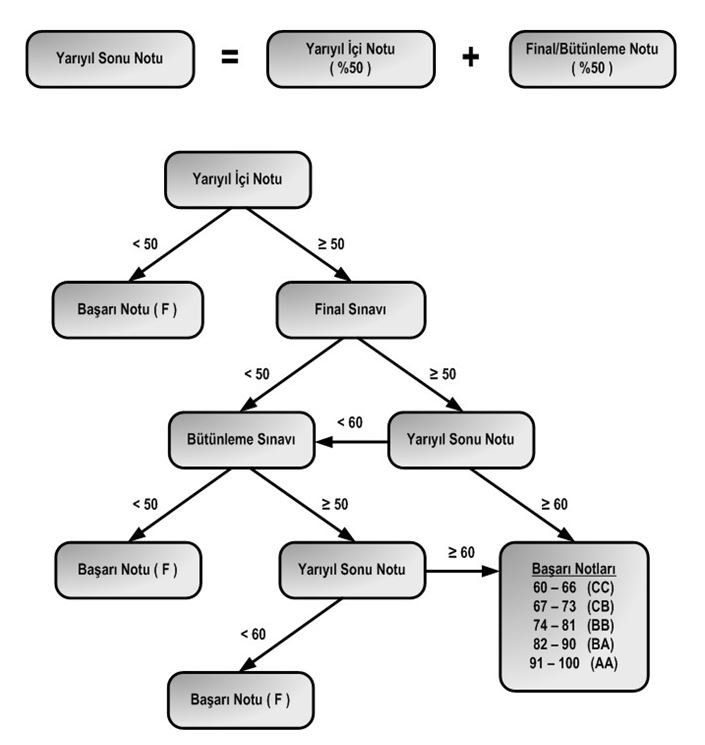
- A student who receives one of the grades AA, BA, BB, CB and CC is considered to be successful. If the student's success grade for a course is F, the student is considered to fail the course.
- There is no make-up exams for finals and resit exams.
- There is no grade increase exams for the courses opened by the Foreign Language Department.
- Within three working days of the announcement of the final exam results, the students may apply to the Department of Foreign Languages with a petition and request that the exam paper to be re-examined in terms of material error.
- Students may reject to their grades for a course with a petition to the Department of Foreign Languages within three business days of the announcement of their grades.
| Level | A1 | A2 | B1 | B2 | |
Understanding |
Listening |
I can understand familiar words and very basic patterns about me, my family and the near circle, when speaking slowly and clearly. | I can understand the patterns and frequently used words associated with topics that directly concern me. (Eg basic personal and family information, shopping, local environment, occupation). I can understand the basic idea of short, clear, simple messages and announcements. | In environments such as work, school, leisure time, etc. I can understand the outline of the clear, standard speech that is constantly evident in the media. I can understand the main points of most of the radio and television programs related to current events or issues of personal interest when it is slow and clear. | I can understand the long speeches and presentations provided that it is a current topic, I can follow the discussions made with the complicated whole. I can understand most of the programs on television news and current affairs. I can understand most of the movies where the standard language is used. |
Reading |
I can understand notices, words and very simple totals in written texts like catalogs, announcements or banners. | I can read short and simple texts. I can understand general information in simple everyday texts such as advertisements, manuals, menus and timelines, and understand short personal letters. | I can understand texts that contain vocabulary or the most frequently used words on a daily basis. I can understand the events, feelings and wishes mentioned in personal letters. | I can read articles and reports on current issues, which authors have adopted a certain attitude or opinion. I can understand contemporary literary prose. . | |
SPEAKING |
Spoken interaction |
I can communicate in a simple way, provided that the person in the interview helps me repeat what I say at a slower rate of speech and what I want to say. I can ask and answer simple questions in the field of that moment's needs or in the fields of very informal subjects. | I can communicate in simple and routine things that require direct information exchange on informed topics and activities. I can participate in short conversations as much as I can, even if I usually cannot understand the whole conversation in order to keep talking. | I can deal with many situations that can occur when traveling in the country where the language is spoken. I can participate in conversations without making preparations on topics that are obvious, or I am interested in, or about everyday life (eg family, hobbies, work, travel and current affairs). | I can communicate fluently and naturally with the native speakers of the language. I can play an effective role by explaining supporting my own opinions in the discussions.. |
Spoken Production |
I can use simple patterns and phrases to describe the place I live and the people I know. | I can use a simple language and a series of phrases to describe my family and other people, my living conditions, my educational background, and my recent work. | I can connect various patterns in a simple way to describe my experiences, dreams, hopes, wishes and events. I can briefly list the explanations and reasons for thoughts and plans. I can tell a story, I can pass on the story of a book or a movie and I can express my impressions. | I can provide clear and detailed information on various topics of interest. I can comment on a topic by showing the positive and negative aspects of various options. | |
WRITING |
Writing |
I can write postcards in short and simple phrases such as sending regards with a holiday card. I can fill out forms with personal information. For example: Name, nationality and address in a hotel registration form. | I can write short, simple notes and messages. I can write very short personal letters such as a thank you note. | I can write a text related to a topic that is familiar or interesting. I can write personal letters describing my experiences and impressions. | I can write elaborate texts that are understandable in a wide variety of topics of interest. I can write a composition or a report that provides information by supporting or opposing to a specific point of view by explaining reasons. I can write letters that highlight the importance of the events and experiences.. |